 |
a division of  |


Search Engines
How American consumers found Web sites
to research purchases:
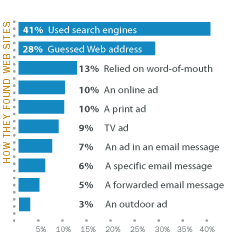
(from Doubleclick, March 2003)
Source: eMarketer


I highly recommend the above book and newsletter. It's updated monthly through an on-line subscription.
Getting ranked high up on the search engines involves setting up multiple "entry pages" for each of the top 10 search engines for each keyword. The process is an adage to the saying, "You get out of it what you put into it." There are no shortcuts. I recommend reviewing your placement in the top 10 search engines monthly and then tweaking your keyword density and placement accordingly. Unfortunately, search engines re-index sites only every 30-90 days. So it's a slow process.
Also...
Search Engine Watch
This site belongs to search engine expert Danny Sullivan and
is packed full of the most recent search engine developments.
http://www.searchenginewatch.com
Search Engine Guide
This site provides a wealth of information and articles
about all aspects of search engines. Weekly and daily
newsletters are offered, which compile updates and
information from across the industry.
http://www.searchengineguide.com
 |
Through a series of simple steps, Wordtracker shows you which are the best keywords to use for the pages on your site.
Wordtracker's suggestions are based on over 300 million keywords and phrases that people have used over the previous 90 days. (In other words, there is no "guessing" when you use Wordtracker. Everything is based on the keywords millions of people have actually typed into search engines.)
Best of all, our competitive analysis tool enables you to find those "best keywords" - the ones your potential customers use, but which your competitors don't know about.
Media Metrix
Search Engine Ratings
By Danny Sullivan
Editor, SearchEngineWatch.com
Oct. 12, 2000
http://www.searchenginewatch.com/reports/mediametrix.html
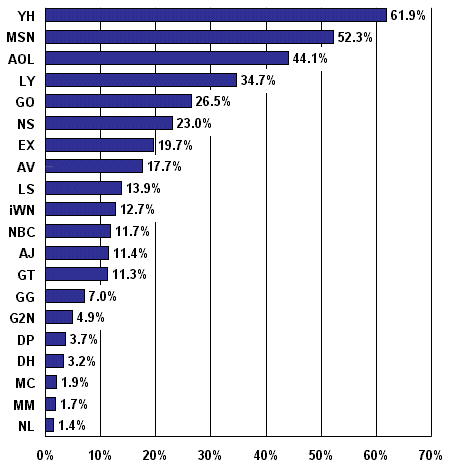
KEY: YH=Yahoo, MSN=MSN, AOL=AOL, LY=Lycos, GO=Go (Infoseek), NS=Netscape,
EX=Excite, AV=AltaVista, LS=LookSmart, iWN=iWon, NBC=NBCi (Snap),
AJ=Ask Jeeves, GT=GoTo, GG=Google, G2N=Go2Net, DP=DogPile, DH=Direct Hit
MC=MetaCrawler, MM=Mamma, NL=Northern Light.
Submitting your site
The best way to submit your site to the search engines is to put a link to your site from a site that's been around for a while and is indexed by all the major search engines. Next time the search engines visit that site, they'll follow the link to your site. Then you're all set.
You can manually submit to all the search engines, but it won't speed things up at all. And definitely beware of any spam that tells you they'll submit your site for you. At best these companies will waste your money. At worst, these companies may get you blacklisted.
Graphics vs. Text for Hyperlinks
See http://www.your-shopper.com/. This is an excellent example of a site that uses graphic links, but also adds text links at the bottom. Search engines much prefer to follow text links.
Also http://tlc.ousd.k12.ca.us/~acody/cartoonlaws.html
While the significance of portals in driving traffic may be waning, ActivMedia found that small-budget online marketers (with annual promotional budgets averaging less than $5000 per year), continue to rate search-engine positioning as the most effective site promotion technique:
| Site Promotional Method | Rated Excellent/Very Good |
| Search engine positioning | 66% |
| 54 | |
| Brochures | 42 |
| Catalogs (Print) | 40 |
| Tradeshows | 37 |
Source: Sep. 1999 ActivMedia Research LLC
Meta Tags
http://www.searchenginehelp.com
Table Trick
Class Exercise:
The point of this exercise is to learn how to count keywords, both visible and not visible.
- Find a competitive web-site that ranks well in a major search engine. Try www.google.com if you like.
- Select All (Ctrl A) and Copy it (Ctrl C)
- Paste this into a blank Word document.
- Do a search and replace for a keyword replacing it with itself. This counts the number of occurrences of this word.
- Go back to the web-page in your browser.
- Click on "View" and then "Source" and Select All (Ctrl A) and Copy it (Ctrl C)
- Paste the source (Ctrl V) into a blank Word document
- Do a search and replace for the same keyword as above and see if the count is the same.
How long does it take for your web page submissions to be indexed?
Altavista 1 - 2 weeks
Excite, Lycos 4 weeks
HotBot 2 weeks
Google 4 - 6 weeks
Infoseek, Go 6 - 8 weeks
Northern Light 2 - 4 weeks
Webcrawler 3 months
Source: NetMechanic.com
A simple and logical SEO (Search Engine Strategy) you can try.
http://www.searchengineblog.com/colums/three_page_optimisation.htm
Interesting article on how to find a Search Engine Optimization (SEO) company.
http://www.ranksmart.com/articles/
what-to-do-if-your-the-seo-client-nobody-wants.html

provides a keyword density counter
http://tools.seobook.com/general/spider-test/index.php

Web Site Hosting | Domain Name Registration | Web Site Design
info@hammock.net
| 800-654-2002 | 509-493-2296 | 1099 Snowden Road • White Salmon,
WA 98672 | U.S.A.
J. Hammock & Associates,
LLC - © 2006